
A New Standard From Skylight Innovation to Large-Span Design Freedom
Visual Clarity & Sky Experience
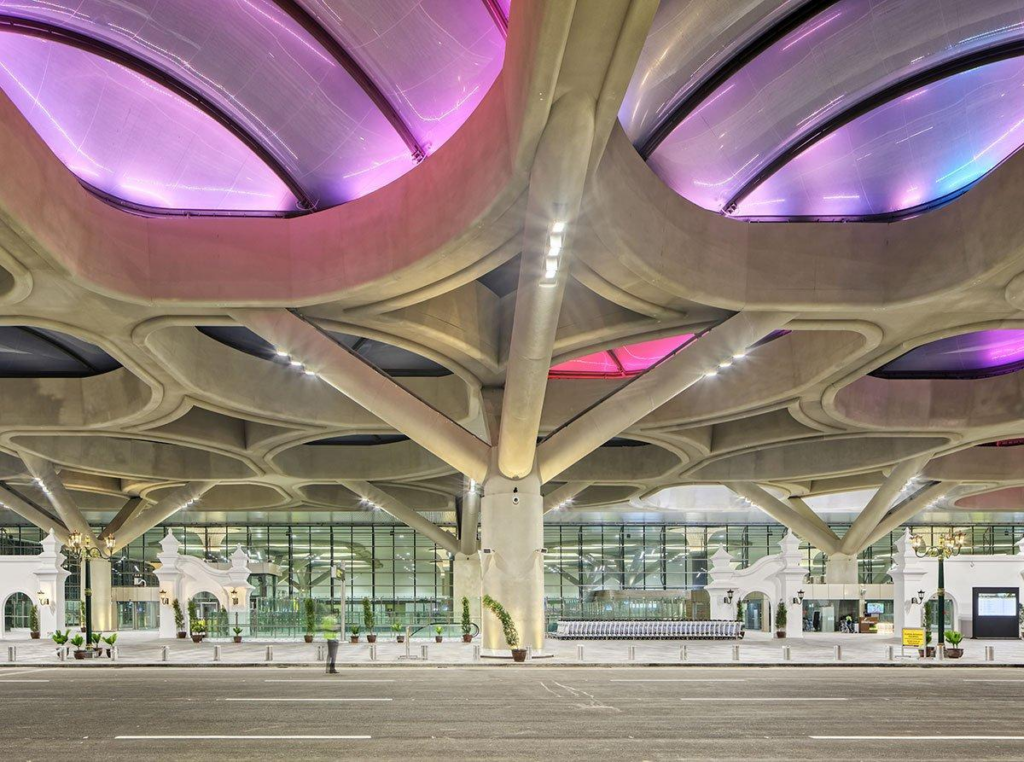
One of the most noticeable qualities of ETFE is the way it changes how people experience light and space. Instead of feeling like a roof is “covering” the building, ETFE creates a sense of openness where the boundary between indoors and outdoors becomes much softer.
With very high light transmission (often up to 94–97%), ETFE allows daylight to penetrate deeply into the building. But more important than brightness is the quality of transparency. Because ETFE systems do not rely on thick glass panels, heavy frames, or repetitive structural grids, the ceiling above feels continuous and calm.
In contrast, traditional glass skylights—even when highly transparent—still introduce visual interruptions through mullions, joints, and support frames. These elements create a subtle but constant “visual noise” that breaks the sky into fragments.
With ETFE, that fragmentation disappears. The result is a space that feels lighter, more open, and more naturally connected to its environment, which is why it is widely used in airports, public plazas, and large interior atriums where human comfort is critical.
Structural Efficiency & Lightweight Advantage
From a structural point of view, ETFE fundamentally changes how roofs are designed. The most important factor is weight.
ETFE weighs roughly 0.3–1.0 kg/m², while glass skylight systems typically weigh 25–40 kg/m². This is not just a small improvement—it is a major structural shift.
Because the material is so light, the supporting structure can be significantly reduced. Steel members can be smaller, foundations can be lighter, and long spans become more achievable without excessive reinforcement. In many cases, intermediate supports that would normally be required for glass systems can be reduced or even eliminated.
This reduction in load does more than save material—it opens up architectural possibilities. Engineers can design more efficient structures, while architects gain larger, more flexible interior spaces with fewer visual interruptions from structural elements.
Construction Speed & Installation Efficiency
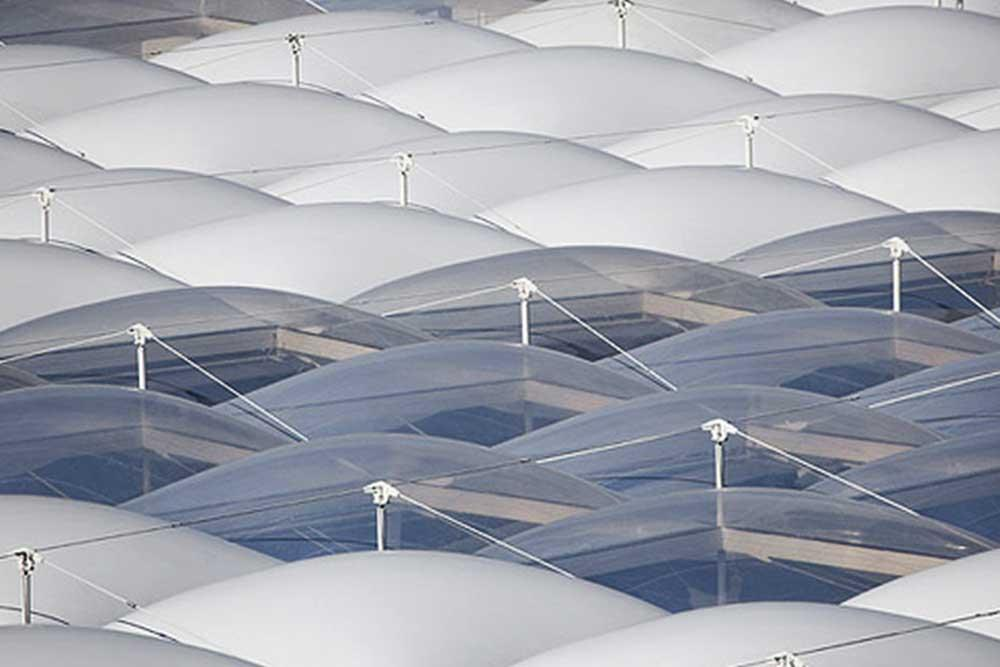
Construction methodology is another area where ETFE differs significantly from glass.
Glass skylights require careful handling of rigid, heavy panels. Each unit must be lifted, aligned, and fixed using cranes or vacuum lifting equipment. Installation is highly sequential and sensitive to weather conditions, meaning delays are common and coordination is complex.
ETFE systems are much more streamlined. The material is delivered in lightweight sheets or pre-formed cushions, installed into framing systems, and then inflated into their final shape on site.
This approach reduces reliance on heavy machinery and allows multiple sections to be installed in parallel. In practical terms, ETFE can reduce installation time dramatically, often allowing roofing works to be completed in a fraction of the time required for glass systems.
This speed does not only improve construction efficiency—it also reduces site risk, lowers labor intensity, and allows earlier access to interior trades and building occupancy.
Design Flexibility & Architectural Freedom
ETFE provides a level of geometric freedom that is difficult to achieve with conventional glass systems.
Glass performs best in flat or gently curved forms because fabrication becomes complex, expensive, and limited when curvature increases. As geometry becomes more advanced—such as domes, organic shapes, or free-form structures—the cost and engineering complexity rise significantly.
ETFE behaves differently. It can be formed into a wide range of architectural geometries without the same cost escalation. This includes domes, barrel vaults, saddle shapes, and highly expressive free-form roof structures.
Because ETFE cushions are flexible and lightweight, they can adapt to complex structural frameworks without requiring heavy prefabrication or specialized glass bending processes. This allows architects to focus more on design intent rather than material limitations.
As a result, ETFE is often chosen for landmark architecture where form, identity, and expression are key design drivers.
Fire Performance & Safety
Fire safety is an important consideration in any roofing system, especially in large public buildings.
Glass, under high heat, does not burn but can fail due to thermal stress. When it shatters, it produces heavy fragments that may fall into occupied spaces and obstruct evacuation routes. It can also trap smoke beneath the roof structure, reducing visibility and complicating evacuation.
ETFE behaves differently under extreme temperatures. Instead of shattering, it softens and retracts. This creates openings in the roof membrane, allowing smoke to naturally escape upward. This “self-venting” behavior can improve visibility and reduce smoke accumulation during emergencies.
Importantly, ETFE does not produce sharp debris when it fails, reducing secondary hazards for occupants below. This behavior makes it particularly suitable for large gathering spaces where evacuation safety is a critical design requirement.
Sustainability & Environmental Performance
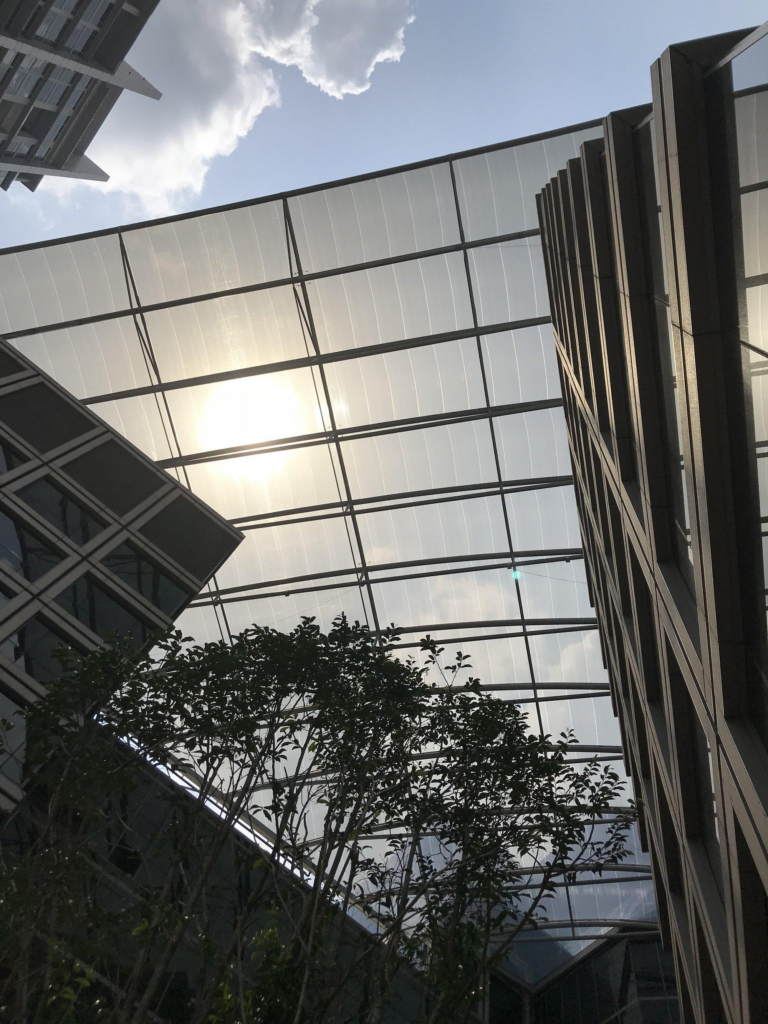
Sustainability is increasingly a central factor in material selection, and ETFE offers several environmental advantages across its lifecycle.
Because it is lightweight, ETFE reduces transportation emissions and requires less structural material, which lowers embodied carbon in the building itself. During operation, its high transparency supports strong daylight penetration, reducing the need for artificial lighting in daytime conditions.
ETFE systems are also fully recyclable, meaning the material can be recovered and reused at the end of its service life. Compared to traditional skylight systems, this supports a more circular approach to material usage in construction.
Overall, ETFE contributes to lower environmental impact not only in manufacturing but throughout construction, operation, and end-of-life stages.
Durability, Maintenance & Lifecycle Value
ETFE systems are designed for long service life, typically in the range of 25–30 years or more depending on design conditions and maintenance practices.
One of their key advantages is low surface adhesion. Dust and dirt do not easily stick to ETFE membranes, and rainfall often removes most surface contamination naturally. This results in reduced cleaning frequency and lower maintenance demands over time.
Glass systems, on the other hand, require more regular cleaning and often involve ongoing maintenance of seals, joints, and framing elements as they age.
Over time, ETFE generally provides more stable performance with fewer interventions, which reduces disruption to building operations and improves long-term usability.
Total Lifecycle Cost Advantage
When all factors are considered together—construction, structure, maintenance, energy performance, and financing—the total lifecycle cost difference between ETFE and glass becomes significant.
ETFE benefits from lower initial structural requirements, faster installation, reduced maintenance costs, and improved operational efficiency. These advantages compound over time, especially in large-span applications.
Glass systems may have familiar upfront costing structures, but over a 20–30 year period, ongoing maintenance, cleaning, and structural demands increase total expenditure significantly.
As a result, ETFE often delivers stronger long-term economic performance when evaluated on a full lifecycle basis rather than initial installation cost alone.
Summary: Why ETFE Is Increasingly Preferred
Across all key performance areas, ETFE consistently demonstrates advantages in:
- Daylight quality and visual clarity
- Structural efficiency and reduced weight
- Construction speed and simplicity
- Architectural freedom and geometry
- Fire behavior and safety performance
- Environmental impact and sustainability
- Long-term lifecycle cost
Final Design Perspective
ETFE cushion roofing systems are increasingly being adopted in modern architecture not as an experimental material, but as a practical and high-performance solution for skylights and large-span structures.
TE Membrane provide invaluable insights and solutions in the area of tensile fabric structure. Their experience ensures your project benefits from cost-effective, aesthetically pleasing, and structurally sound designs in tensile membrane manufacturing and completion of tensile membrane structure for roof and wall. Collaborate with them to expertly manage geometry selection, fabrication, and installation for a successful outcome ETFE membrane structure specialist.
This article is for educational and informational purposes only. All comparisons are based on general industry data and typical engineering assumptions and may vary depending on project design, location, and specifications.
All images used are royalty-free stock photographs sourced . They are used strictly for illustration and do not represent any real project, company, or construction work.