
Speed Wins: Why ETFE Structures Install in Weeks, Not Months
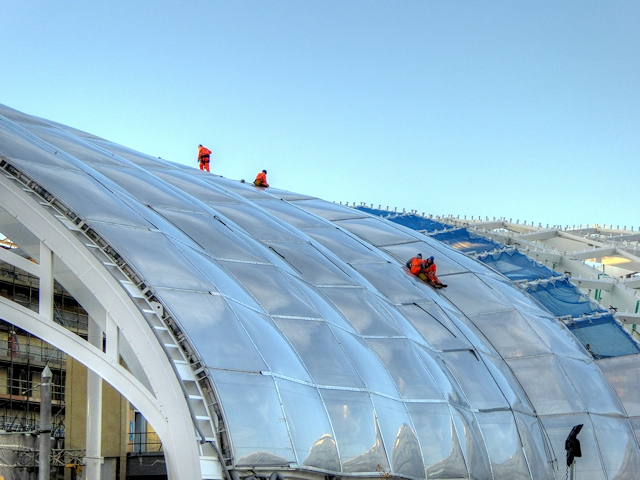
When a project reaches the roofing stage, time becomes one of the most valuable resources on site. In today’s fast-track construction environment, the choice between ETFE structures and traditional glass roofing is no longer purely aesthetic—it directly impacts project speed, cost efficiency, and overall delivery performance.
Key takeaway:
- Faster roof installation = faster project completion
- Reduced delays = better cost control
- Earlier completion = earlier revenue generation
ETFE Structures: Engineered for Speed and Simplicity
Unlike glass, ETFE roofing systems are designed with speed and efficiency in mind. The material is lightweight and flexible, typically delivered in rolls or prefabricated cushions. This drastically simplifies logistics, handling, and installation.
Once the structural frame is prepared, ETFE foil is installed by clamping it into aluminium profiles and inflating it to form cushions. The process eliminates the need for heavy machinery and reduces reliance on highly specialised labour. As a result, installation becomes faster, safer, and more predictable.
Why ETFE structures install faster:
- No crane or heavy lifting equipment required
- Lightweight material allows rapid handling
- Simplified installation process (clamp and inflate)
- Reduced weather dependency
- Smaller, more efficient installation teams
Time Comparison: ETFE vs Glass Roofing Systems
When comparing timelines for a 1,000m² roof, the difference becomes clear. Glass systems involve longer fabrication lead times and sequential installation phases, often extending total project duration to three or four months.
ETFE structures, by contrast, benefit from faster fabrication and streamlined installation, reducing total time to as little as one to two months.
Typical project timeline:
- Glass roofing: 3–4 months total duration
- ETFE roofing: 1–2 months total duration
- Speed advantage: ETFE is typically 5–10x faster in installation phase
Why Speed Matters in Construction Projects
Speed is not just about finishing early—it has a direct impact on cost, risk, and profitability. Faster installation reduces the number of days workers spend on site, lowering labour costs and minimising overhead expenses. It also reduces exposure to weather-related risks, which can otherwise disrupt schedules and increase costs.
Conclusion: Speed is a Competitive Advantage
In construction, time directly translates into cost and opportunity. Choosing a roofing system that can significantly reduce installation duration provides a clear competitive edge.
ETFE structures offer that advantage by transforming a traditionally slow and complex process into a fast, efficient workflow. By cutting installation time from months to weeks, ETFE enables smoother project delivery, better cost control, and earlier revenue generation.
Final summary:
- ETFE installs faster than glass by a wide margin
- Faster installation reduces cost and risk
- Early completion improves financial returns
- ETFE is ideal for modern, fast-track construction projects
TE Membrane provide invaluable insights and solutions in the area of full design & engineering in tensile fabric structure. Their experience ensures your project benefits from cost-effective, aesthetically pleasing, and structurally sound designs in tensile membrane manufacturing and completion of tensile membrane structure for roof and wall. Collaborate with them to expertly manage geometry selection, fabrication, and installation for a successful outcome ETFE membrane structures roof and facades specialist.
This article is for educational and informational purposes only. All comparisons are based on general industry data and typical engineering assumptions and may vary depending on project design, location, and specifications.
All images are used strictly for illustration and do not represent any real project, company, or construction work. image source: https://commons.wikimedia.org/wiki/File:New_Roof_Under_Construction_at_Victoria_Station_-geograph.org.uk-_4271710.jpg