
Less Steel, Bigger Ambitions
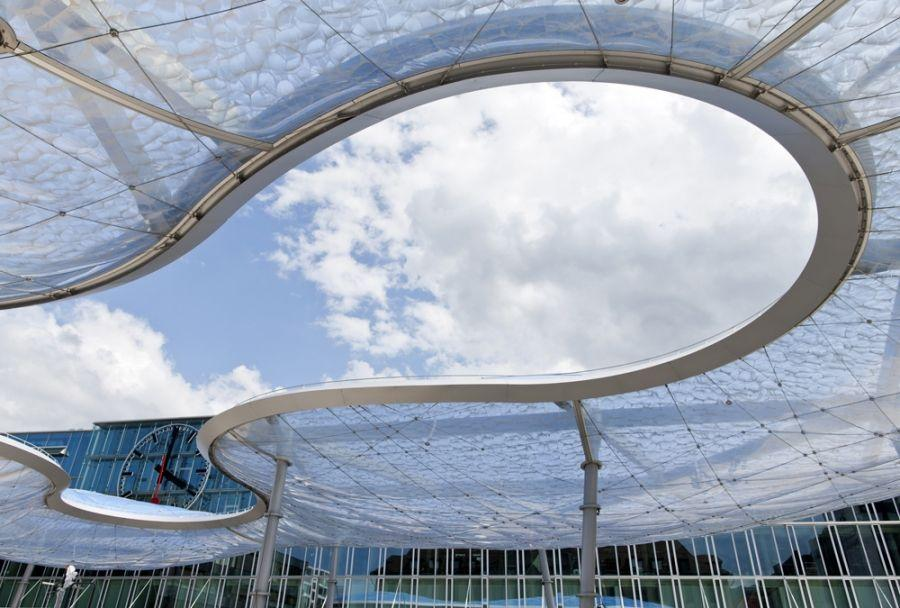
For a long time, architects didn’t design freely—they designed within limits. And more often than not, those limits were defined by glass.
Glass has always been admired for its clarity and elegance, but behind that beauty lies a heavy structural burden. Every square meter adds weight, and as the surface area increases, so does the need for stronger beams, thicker columns, and deeper foundations. Over time, this creates a chain reaction: heavier materials require more support, which increases cost, complexity, and construction time. As a result, many design ideas are quietly scaled down before they ever reach the drawing board.
This is where ETFE begins to change the narrative.
Unlike glass, ETFE design is exceptionally lightweight—so light that it fundamentally alters how buildings are conceived. Instead of designing a structure to carry the material, designers can now think about how the material can enable the structure. This shift may sound subtle, but in practice, it opens up an entirely different approach to architecture.
A Structural Mindset Shift
When you reduce the weight of a roofing system by up to 90–95%, you are not just saving material—you are redefining the entire structural strategy of a building.
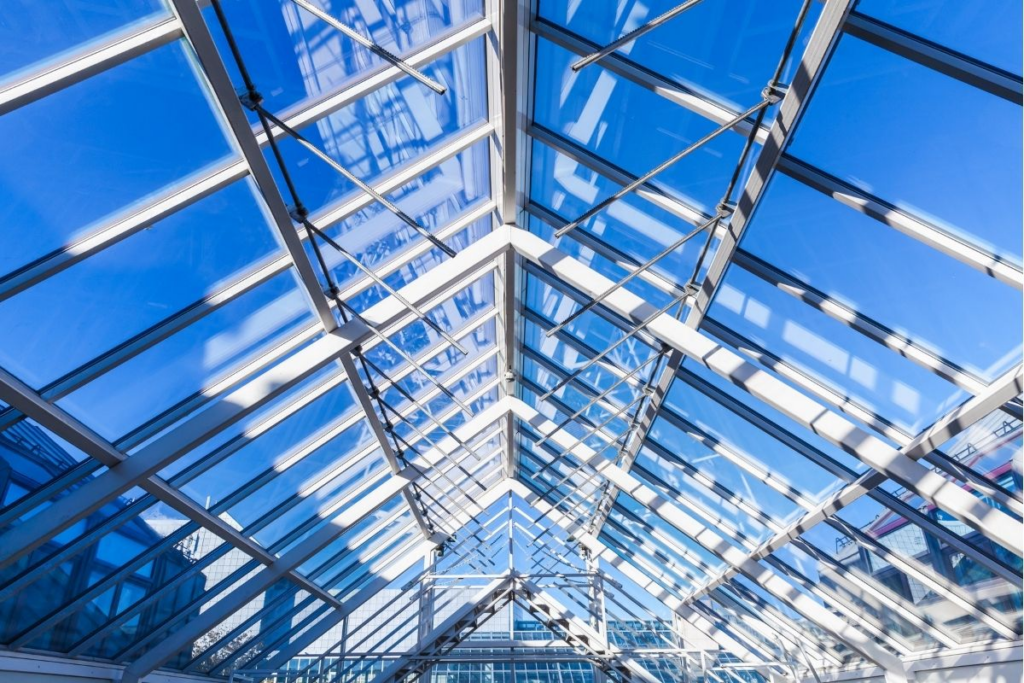
With traditional glass roofing, large spans demand heavy steel frameworks. These frameworks are often dense and visually intrusive, breaking up interior spaces and limiting openness. Structural engineers must carefully balance load distribution, often adding layers of reinforcement just to maintain safety and performance.
ETFE structure removes much of that burden. Because it is so light, the forces transferred to the supporting structure are dramatically reduced. This allows engineers to design slimmer, more efficient framing systems, and in some cases, even replace rigid structures with tension-based systems. The result is a building that feels lighter—not just physically, but visually and spatially as well.
For architects, this shift is incredibly empowering. It means fewer compromises between design intent and structural feasibility. Instead of asking, “Can the structure support this?” the conversation becomes, “How far can we push the design?”
Creating Space Without Interruption
One of the most noticeable benefits of ETFE is the ability to create large, uninterrupted spaces. In many public buildings—such as airports, stadiums, and exhibition halls—open space is not just desirable; it’s essential.
With glass, achieving wide spans often requires internal supports. Columns and beams become necessary to carry the load, but they also interrupt sightlines and reduce flexibility in how the space is used. Over time, these structural elements can limit both functionality and aesthetic impact.
ETFE design changes this dynamic. Because the material is so lightweight, it allows for significantly larger spans with minimal support. This means fewer columns, cleaner interiors, and more adaptable пространства. Visitors experience a sense of openness that would be difficult—or extremely costly—to achieve with traditional materials.
In many ways, ETFE roof enables architecture to feel more natural. Spaces flow more freely, light enters more evenly, and the boundary between interior and exterior becomes less rigid.
Freedom in Form and Geometry
Another area where ETFE stands out is in its flexibility of form. Glass, while versatile to a degree, performs best in flat or gently curved applications. As soon as a design moves into complex geometry—double curvature, organic shapes, or free-form surfaces—the cost and difficulty increase rapidly.
ETFE behaves differently. It can be shaped, molded, and adapted without the same level of cost escalation. This allows architects to explore more expressive forms without constantly worrying about fabrication constraints.
What this means in practice is that buildings no longer need to conform to rigid geometries. Roofs can curve and flow naturally. ETFE facades can take on dynamic shapes that respond to environmental conditions or aesthetic goals. Instead of forcing a design into straight lines and flat panels, ETFE membrane allows the design to evolve more organically.
This flexibility is especially valuable in modern architecture, where identity and visual impact play a significant role. Iconic buildings are often defined by their ETFE provides a toolset that makes those shapes more achievable.
Looking Ahead
ETFE structures is not simply replacing glass—it is redefining what is possible in architectural design. By reducing structural constraints and enabling greater freedom in form, it allows buildings to become more than just functional spaces. They become experiences.
As more architects and engineers adopt ETFE-first thinking, we can expect to see a new generation of structures that are lighter, expressive, and more efficient.
That’s why more projects today are turning to ETFE roof specialists and contractors to deliver modern, high-performance roofing systems.
TE Membrane provide invaluable insights and solutions in the area of tensile fabric structure. Their experience ensures your project benefits from cost-effective, aesthetically pleasing, and structurally sound designs in tensile membrane manufacturing and completion of tensile membrane structure for roof and wall. Collaborate with them to expertly manage geometry selection, fabrication, and installation for a successful outcome ETFE membrane structures roof and facades specialist.
This article is for educational and informational purposes only. All comparisons are based on general industry data and typical engineering assumptions and may vary depending on project design, location, and specifications.
All images are used strictly for illustration and do not represent any real project, company, or construction work.